

Database Schema Synchronization: Methods and Best Practices for Teams in 2026
Database schema synchronization maintains structural consistency across multiple databases or systems – a foundational requirement for teams managing complex, distributed architectures. Log-based Change Data Capture (CDC) has become the standard approach, capturing every change including deletes with minimal performance impact on source systems. This article explores three core synchronization methods (one-way, bidirectional, and hub-and-spoke), their technical trade-offs, and proven best practices for avoiding common pitfalls like circular loops and unhandled conflicts. Teams implementing proper schema synchronization gain real-time visibility into structural changes, maintain data governance standards, and significantly reduce deployment risks across distributed systems.
Table of contents
- What is Database Schema Synchronization?
- Three Core Synchronization Methods
- How Does Change Data Capture Work in Practice?
- Best Practices for Effective Schema Synchronization
- Common Challenges and Solutions
- Choosing the Right Approach for Your Architecture
- Why Documentation and Governance Matter as Much as Sync Itself
- Frequently Asked Questions
What is Database Schema Synchronization?
Database schema synchronization is the process of propagating structural changes – table definitions, column types, indexes, constraints – across two or more database instances so they remain consistent. It differs from data replication (which moves rows) by focusing on the structure that governs how data is stored and interpreted.
Definition and core concepts
At its core, schema synchronization answers a simple question: when a table changes in one system, how does every other system that depends on that table learn about it and adapt? The answer involves detecting changes (through transaction logs, scheduled queries, or explicit triggers), validating compatibility, and applying modifications in a controlled sequence. The three building blocks are: change detection, conflict resolution, and applied propagation.
Why synchronization matters in multi-system architectures
Modern architectures rarely rely on a single database. Microservices, read replicas, analytics stores, and staging environments each hold a copy of some schema subset. When a developer adds a nullable column to a production table without synchronizing downstream systems, queries break silently. According to Streamkap (verified 2026-09-08), the most common pitfalls include syncing unnecessary fields, ignoring data validation, inadequate monitoring, and creating circular loops in bidirectional scenarios – all failures that compound when teams lack a shared view of schema state.
Three Core Synchronization Methods
Three architectural patterns cover the vast majority of real-world synchronization needs, each suited to a different topology and risk profile.
One-way synchronization: Master-slave replication
One-way (or unidirectional) synchronization designates a single authoritative source and propagates changes outward to one or more replicas. Writes happen only on the primary; replicas are read-only consumers. This eliminates conflict by design – there is no ambiguity about which version wins because only one system can produce changes.
PostgreSQL introduced built-in streaming replication based on write-ahead log (WAL) technology in version 9.0 (Severalnines, verified 2026-09-08), making unidirectional sync a native capability rather than a third-party add-on. MySQL takes a comparable approach: it uses row-based binary logging (binlog_format=ROW) as the default to replicate individual row changes rather than SQL statements (Hevo Data, verified 2026-09-08), which produces more predictable schema-level consistency.
One-way sync is the right default when the primary use case is scaling reads, maintaining disaster-recovery replicas, or feeding a reporting layer that never writes back.
Bidirectional synchronization and conflict management
Bidirectional synchronization allows writes on multiple nodes, with changes propagated in both directions. The benefit is obvious: any node can accept updates, improving write availability and reducing latency for geographically distributed users. The cost is conflict resolution.
As StackSync documents (verified 2026-09-08), bidirectional synchronization introduces critical conflict resolution challenges when both systems update the same record simultaneously. Teams must define explicit policies before going live: last-write-wins (based on timestamp or sequence number), source-priority rules, or application-level merge logic. Undeclared conflicts silently corrupt data.
Multi-system sync: Hub-and-spoke architectures
Hub-and-spoke extends the bidirectional model to three or more participants by routing all changes through a central hub. Spokes never communicate directly with each other; the hub deduplicates, validates, and re-distributes. This reduces the number of synchronization pathways from O(n²) to O(n), making monitoring and conflict detection tractable at scale. The trade-off is that the hub becomes a single point of failure and a potential bottleneck – it must be designed for high availability from the start.
How Does Change Data Capture Work in Practice?
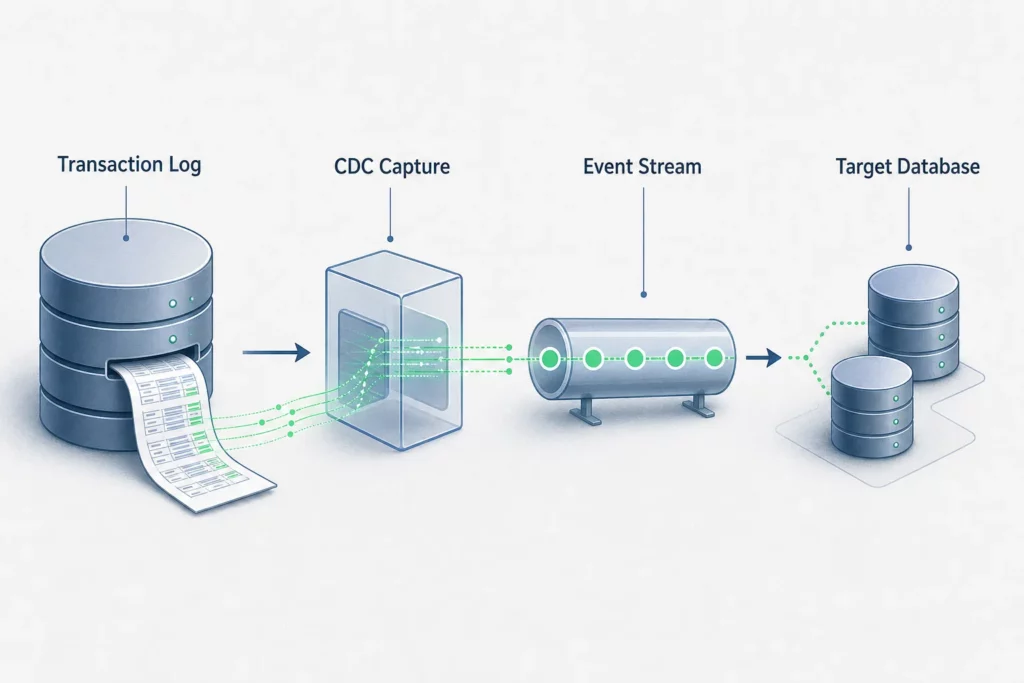
Change Data Capture (CDC) is the technical mechanism that powers most production synchronization pipelines, regardless of the architectural pattern chosen above.
How CDC works with database transaction logs
Instead of polling tables with periodic queries, log-based CDC reads directly from the database engine’s internal transaction log – WAL for PostgreSQL, binlog for MySQL, transaction log for SQL Server. Every INSERT, UPDATE, DELETE, and DDL statement is recorded in the log before it is applied. A CDC consumer reads that log asynchronously, translates entries into a structured change stream, and forwards them to downstream systems. Because it reads a log that the database already maintains, it introduces no additional locking on source tables.
CDC vs. query-based extraction methods
Query-based extraction runs a scheduled SELECT (often with a WHERE updated_at > ? predicate) to find changed rows. It is simple to implement but carries three structural limitations: it misses hard deletes (deleted rows leave no trace), it requires a reliable timestamp column on every table, and it imposes query load on the source system during extraction windows. Real-time CDC provides lower latency and reduced load on source systems compared to query-based extraction methods (Striim, verified 2026-09-08).
Why CDC minimizes source system impact
Because CDC reads an already-existing log file rather than executing queries, the source database experiences no additional transaction overhead. At peak load – precisely when query-based polling would be most disruptive – CDC remains a background reader with a near-constant footprint. This makes it the standard recommendation for production systems where source availability is non-negotiable.
Best Practices for Effective Schema Synchronization
Technical architecture alone does not prevent failures. The following operational practices separate stable synchronization pipelines from fragile ones.
Automate schema detection and validation
Schema changes should never rely on manual notification. Automated detection – connecting directly to the database engine and diffing the current schema against a stored baseline – removes the human step that most often breaks synchronization. Automatic schema import and detection eliminates the lag between when a change is deployed and when downstream consumers learn about it. Pair detection with validation gates: before propagating a change, verify that it does not break existing foreign keys or violate downstream constraints.
Define clear conflict resolution policies
Every bidirectional or multi-master setup needs a conflict resolution policy written down before the first record is synchronized. The policy should cover: which field determines recency (timestamp, sequence, or version counter), what happens when timestamps are equal, and who is notified when an automated resolution fires. Teams that treat conflict resolution as an afterthought inherit invisible data corruption.
Monitor and audit changes in real-time
Synchronization pipelines fail silently more often than they fail loudly. Monitoring means tracking lag (how far behind is the replica?), error rates on applied changes, and schema divergence – a metric most teams skip. Auditing means keeping an immutable log of every structural change with its author, timestamp, and target systems. This log becomes the foundation for compliance and incident investigation.
Common Challenges and Solutions
Even well-designed synchronization pipelines face recurring failure modes that teams encounter as systems mature.
Schema drift and version mismatches
Schema drift occurs when replicas fall out of sync with the primary over time – a column is renamed in production but the replica still references the old name, or a NOT NULL constraint is added without updating the replica’s table definition. Drift accumulates through hotfixes applied directly to production, migration scripts that run partially, and deployments that skip schema verification steps. The solution is to treat schema state as a versioned artifact: every change goes through a migration with a unique version identifier, and automated checks confirm all targets are at the expected version before deployment proceeds.
Latency in real-time synchronization
Network latency, log reader lag, and downstream transformation time all compound. For log-based CDC, the primary levers are: keeping the consumer close to the source (same region or availability zone), sizing the consumer’s throughput to handle peak log volume without queuing, and avoiding expensive transformations in the critical path. Latency budgets must be defined per use case – a read replica serving user-facing queries has a much tighter SLA than an analytics clone.
Preventing circular loops in bidirectional scenarios
In bidirectional setups, a change applied to Node B in response to a change from Node A must not be re-propagated back to Node A as a new change. Without loop prevention, a single update cascades indefinitely. The standard countermeasure is to tag each change with its origin node identifier; consumers skip changes that originated from themselves. Any CDC framework used in a bidirectional topology must support origin tagging natively or it will create loops under load.
Choosing the Right Approach for Your Architecture

Selecting a synchronization method is an architectural decision with long-term implications – it shapes your failure modes, operational complexity, and scaling path.
Assessing your system topology and requirements
Start with two questions: how many systems need to share the schema, and which of them need write capability? If writes concentrate on one primary, one-way replication is the simplest and most reliable option. If write availability across multiple nodes is a business requirement, bidirectional or hub-and-spoke becomes necessary – along with the conflict resolution overhead that comes with it.
Evaluating CDC versus traditional replication
For new implementations, CDC should be the default unless the database engine imposes constraints (for example, limited log retention or restricted log access in certain managed cloud configurations). Traditional query-based replication remains viable for low-change-rate schemas where simplicity outweighs latency requirements. Multi-database SQL support for MySQL, PostgreSQL, and SQL Server matters here: a consistent synchronization approach across engine types reduces operational fragmentation.
Scaling considerations as systems grow
Hub-and-spoke architectures that work for five nodes can become bottlenecks at fifty. Plan the hub’s throughput ceiling before you reach it, not after. For very large topologies, federated CDC – where regional hubs aggregate local changes before forwarding to a global hub – distributes the load while maintaining a single logical change stream.
Why Documentation and Governance Matter as Much as Sync Itself
Schema synchronization solves a technical problem – keeping structures consistent – but the teams who benefit from that consistency are not only engineers. Data analysts writing queries, product managers reading table definitions, and support teams diagnosing data issues all need to understand the current schema state across systems.
Keeping teams aligned on schema changes
When schema synchronization runs silently in the background, most team members have no visibility into what changed, when, and why. A synchronized but undocumented schema is opaque to anyone outside the team that manages it. Visualizing synchronized schemas in real-time turns a technical operation into a shared artifact: everyone sees the current structure, the relationships between tables, and the history of modifications. This is what transforms synchronization from infrastructure plumbing into a team capability.
Connecting sync methods to data governance
Data governance frameworks require that structural changes be traceable: who authorized a column rename, what impact did it have on downstream dependencies, and was the change reviewed before deployment? Synchronization pipelines that feed into an audited documentation layer answer these questions automatically. The alternative – reconstructing change history from deployment logs and Slack threads – is both error-prone and unscalable. Schema synchronization and collaborative documentation are not separate concerns; they are two layers of the same governance stack.
Frequently Asked Questions
What is database schema synchronization?
Database schema synchronization is the process of keeping the structural definitions of tables, columns, constraints, and indexes consistent across two or more database instances. It ensures that when a schema change is made in one system, all dependent systems reflect that change in a controlled, validated way.
What are the main methods for synchronizing database schemas?
The three primary methods are one-way (master-slave) replication, bidirectional synchronization, and hub-and-spoke multi-system sync. Each method is supported by a change detection mechanism – most commonly log-based Change Data Capture (CDC) – that captures structural modifications at the source and propagates them downstream.
What is the difference between one-way and bidirectional synchronization?
One-way synchronization designates a single authoritative source; only that source accepts writes, and all replicas receive changes passively. Bidirectional synchronization allows writes on multiple nodes, which maximizes availability but introduces conflict scenarios when two nodes modify the same record simultaneously. One-way is simpler and conflict-free by design; bidirectional requires explicit conflict resolution policies.
How do you handle conflicts in bidirectional schema synchronization?
Conflicts are managed through predefined resolution policies set before synchronization begins. The most common approaches are last-write-wins (using a trusted timestamp or sequence number), source-priority rules (one node’s changes always take precedence in a given domain), and application-level merge logic for complex cases. Whichever policy is chosen, it must be documented, tested, and monitored – undeclared conflicts produce silent data corruption.
What are the latency challenges in real-time schema synchronization?
Latency in real-time synchronization accumulates from three sources: log reader lag (the delay between a change being committed and the CDC consumer reading it), network transit time between source and target, and any transformation processing in the pipeline. Log-based CDC minimizes source-side impact, but consumer throughput must be sized to handle peak log volume without building a queue. Latency budgets should be defined per system based on the actual SLA of downstream consumers.
Which synchronization method should our team choose?
Start with one-way replication if a single system owns all writes – it is the most reliable and operationally simple option. Move to bidirectional or hub-and-spoke only when write availability across multiple nodes is a genuine business requirement. In all cases, pair the synchronization mechanism with automated schema detection and a shared documentation layer so the entire team – not just the engineers managing the pipeline – has visibility into what the current schema looks like and how it is changing.