
Avoid costly mistakes caused by misunderstood schemas
Most database issues don’t come from bad code, they are caused by misunderstandings. Safe SQL development is the key to produce stable applications.
Unclear relationships, hidden constraints, or undocumented dependencies can easily lead to bugs, data corruption, or broken features.
SQLInfo makes your database rules explicit and visible, helping your team work with confidence.
Make database rules transparent, no more guesswork
When constraints and relationships are clearly documented, developers don’t have to guess.
SQLInfo helps you:
- Identify primary and foreign keys
- Understand table dependencies
- View constraints and indexes
- Detect risky relationships before making changes
This reduces ambiguity and improves decision-making
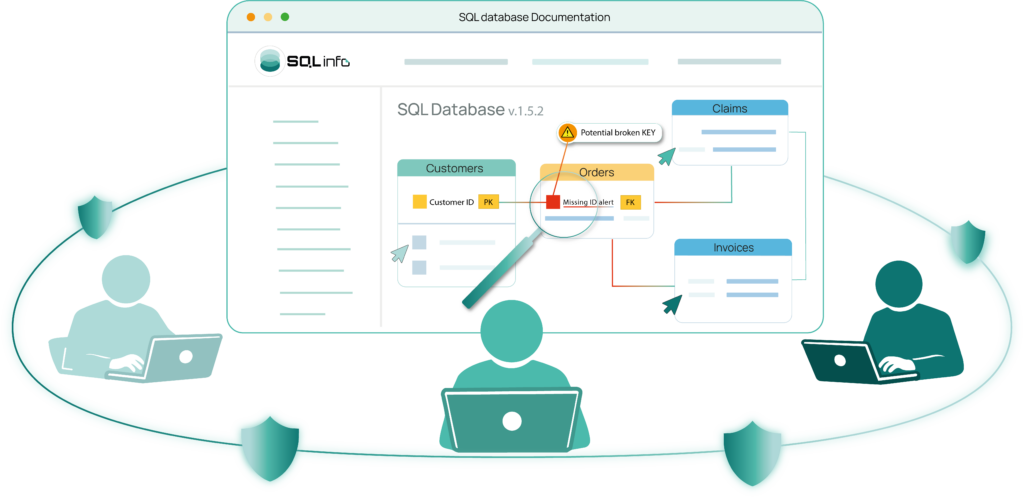
Write safer SQL queries
Better visibility means better queries.
With SQLInfo, teams can:
- Avoid incorrect joins
- Prevent accidental data duplication
- Reduce logical errors in complex queries
- Work safely with legacy schemas
Clear documentation reduces errors before they reach production.
Reduce risk during schema changes
Database updates and migrations are high-risk operations.
Without understanding dependencies, even small changes can break multiple systems.
SQLInfo helps teams:
- Analyze impact before modifying tables
- Identify dependent objects
- Perform safer refactoring and safer development
- Reduce production incidents
Build long-term database reliability
By catching errors early, SQLInfo strengthens your data integrity.
Results include:
- Fewer production bugs
- More stable database evolution
- Increased team confidence
- Better collaboration between developers and DBAs
What you get:
- Safe SQL development
- Clear constraints and keys
- Better understanding of table dependencies
- Lower risk when writing queries
- Safer schema changes and refactoring
- Stronger data integrity
- Build and evolve your database safely
Ready to prevent errors?
Check out this article for more best SQL practices