

How to Implement Data Governance in an SME Without Overburdening the Team
Data governance is not an IT project reserved for enterprise corporations. For a tech SME, it relies on six simple pillars: clear responsibilities, mapping, quality, proportionate security, GDPR compliance, and active steering. With living schema documentation, an SME can deploy operational governance in eight concrete steps at a controlled cost (a shared DPO costs €1,500–€4,000/year) and with a single source of truth accessible to all roles: developers, analysts, product managers, and support teams.
The reality on the ground is concerning: according to CNIL, only 41% of small and mid-sized businesses maintain a processing activities record, even though it is legally required for all companies. According to Integrate.io (2026), 85% of organizations claim to have a governance framework, but only 3% of their data is truly “fit for purpose.” Declared governance and actual governance are two entirely different things.
This article details the concrete steps to implement governance tailored for a tech SME operating with limited resources and scaling progressively.
Table of Contents
- Why Data Governance is Becoming Unmissable for SMEs in 2026
- The 6 Pillars of Governance Tailored for SMEs
- How to Concretely Implement This Governance in 8 Steps
- Comparison Table: A Lightweight Model to Get Started
- GDPR Compliance for SMEs: What Do You Really Need to Do?
- What Tools and Resources to Structure Governance Without Complexity?
- FAQ – SME Data Governance Questions Answered
Why Data Governance is Becoming Unmissable for SMEs in 2026
Without a shared framework, every team manages data according to its own logic, and the business unknowingly accumulates information debt. CRM, ERP, SQL databases, shared spreadsheets: each system becomes a competing version of the truth, and no one knows which one is authoritative.
The Risks of Ungoverned Data: Scattered Records and GDPR Non-Compliance
An SME operating without governance exposes its personal data to concrete risks: poorly secured customer files, data processing lacking documented legal bases, and third-party vendors not compliant with GDPR. A processing activities record is mandatory for all companies regardless of size and not just enterprises with over 250 employees. Beyond regulatory compliance, the operational cost is direct: time wasted searching for which table holds which piece of data, decisions made using outdated exports, and slowed onboarding due to a lack of shared documentation.
Concrete Benefits: Reliable Decision-Making, Secure Usage, and Reduced Information Chaos
An operational governance framework even a lightweight one which ensures you know who uses what data, in which system, and with what level of validity. Decision-making becomes dependable, accesses are tracked, and new hire onboarding happens smoothly without pulling away senior engineers. 86% of companies are increasing their data management investment in 2026 (Integrate.io) with a clear sign that this movement responds to real pressure regarding decision quality.
The Acceleration of AI: An Urgent Need for Understandable and Traceable Data
The adoption of generative artificial intelligence amplifies this challenge. According to Informatica (2026), 69% of companies have integrated GenAI into their business operations, up from 48% the previous year. A model trained on poorly qualified or un-traced data produces unreliable and potentially non-compliant outputs. Governance becomes the core foundation upon which any serious AI strategy rests.
The 6 Pillars of Governance Tailored for SMEs
SME data governance is not a scaled-down version of enterprise frameworks. It rests on six interconnected pillars, each fully actionable without a full-time CIO or multi-month consulting projects.
Pillar 1: Clear Responsibilities – Who Decides, Who Controls
Appointing a designated Data Owner is enough to get started. This role can be filled by the CTO, a lead developer, or a tech-savvy office manager. It does not require 100% of their bandwidth, but it demands a documented mandate and explicit authority within the organization. Without an identified owner, no rules hold up over time.
Pillar 2: Simple Mapping – Inventorying and Locating Data
Before optimizing anything, you must know what exists. A baseline mapping lists systems, data types, owners, and sensitivity levels. For a 20 to 50-person SME, this inventory can be completed in one or two days, not a full quarter-long project.
Pillar 3: Quality and Lifecycle – Single Source of Truth Per Data Field
64% of organizations cite data quality as their main challenge, with 77% rating theirs as average or poor (9cv9, 2026). The remedy begins with a simple rule: one data point, one single source of truth. Prevent duplicate entries between your CRM and ERP, define which table is authoritative for revenue or inventory figures, and set up clear update policies per data owner.
Pillar 4: Proportionate Security – MFA, Backups, and Tracked Access
Security in an SME does not require a full-time CISO. It starts with multi-factor authentication across all critical platforms, quarterly-tested backups (not just scheduled ones), and periodic access reviews. Every access grant to sensitive data must be justified by an actual business need and properly documented.
Pillar 5: GDPR Compliance – Processing Records and Legal Bases
GDPR requires documenting every instance of personal data processing: purpose, legal basis, retention period, and recipients. For a tech SME, this applies to the CRM, authentication logs, billing records, and candidate data if active hiring is underway. A structured 8-column spreadsheet is all you need to launch.
Pillar 6: Active Steering – Audits, Action Plans, and Reviews
Governance without active steering quickly becomes obsolete. Semi-annual reviews allow teams to verify that records remain up to date and that active access rights mirror current workforce setups. To make data understandable and accessible across all team profiles for developers, analysts, product managers, and support teams, living database schema documentation acts as the connective tissue holding these six pillars together.
How to Concretely Implement This Governance in 8 Steps
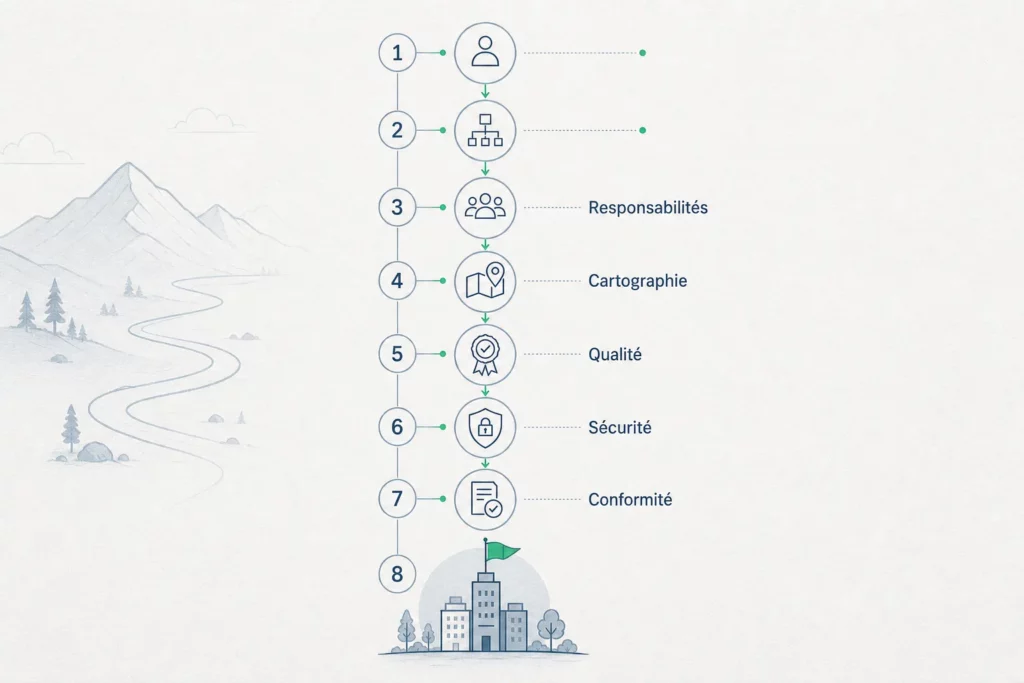
This is the practical angle generic guides skip: a roadmap tailored specifically for a 10 to 100-person tech SME facing limited resources and scaling requirements. These eight steps follow a logical sequence with concrete deliverables at every milestone.
Step 1: Initial Audit – Inventorying CRM, ERP, Excel, and Scattered Data
Spend two days inventorying all systems storing data: SQL databases, SaaS platforms (CRM, support, payments), shared files, and recurring data exports. Identify what contains personal data and what is mission-critical. This step is the only one requiring cross-team input, it rarely takes more than a single sprint.
Step 2: Appoint a Data Owner – Lightweight RACI Framework (Part-Time Friendly)
Formalize your data RACI matrix on a single page: who is Accountable for each system, who is Consulted when making structural decisions, and who is Informed about incidents. This document removes ambiguity without creating bureaucracy. In an SME, the Data Owner acts as a facilitator, not a top-down authority.
Step 3: Build the GDPR Record – Simplified Template with Quarterly Updates
An 8-column template is sufficient: processing activity, owner, purpose, legal basis, data involved, recipients, retention period, and security measures. CNIL provides downloadable templates built specifically for SMEs. Schedule a 30-minute quarterly review, plenty of time to stay compliant provided the initial audit was done right.
Step 4: Establish Access Controls – Role-Based and Need-to-Know Access
Define access levels based on roles (developer, analyst, support, executive) and ensure every active account belongs to a current team member. Revoke access immediately for departed staff. Enable MFA across all critical software. This step takes a single day initially, followed by 30 minutes per quarter for routine maintenance.
Step 5: Define Retention and Archiving – Clear Rules by Data Type
Instead of an overwhelming matrix, start with three simple categories: active data (kept for the duration of the relationship), archived data (kept per statutory requirements), and data scheduled for deletion (anything exceeding legal limits). Document these policies directly inside your GDPR processing record.
Step 6: Secure in Phased Waves – Start with MFA and Backups
Deploy security in three distinct phases: MFA and verified backups in Week 1, access reviews and encryption at rest in Month 1, followed by password policies and incident response planning in Quarter 1. Trying to roll out everything at once guarantees incomplete execution.
Step 7: Document the Database Schema – The Pivot for Understanding and Reuse
This is the exact step generic governance resources miss, yet it is essential for a tech SME. Automatically documenting database schemas, tables, columns, relationships, types, constraints, turns an opaque SQL database into an asset everyone can understand. A tool that imports schemas directly from MySQL, PostgreSQL, or SQL Server without heavy setup cuts timeline execution by weeks. Schema documentation acts as the glue making the six pillars work: without it, teams interpret fields differently, leaving governance purely theoretical.
Step 8: Steering and Iteration – Semi-Annual Reviews and Agile Adjustments
Schedule two half-day reviews per year. Standard agenda: audit GDPR processing records, review active user permissions, check backup health, evaluate recent incidents, and update schema documentation. Data governance is not a finished project: it is an inherently agile maintenance process.
Comparison Table: A Lightweight Model to Get Started
Core Components by Size and Complexity
| Component | SME (10-30 employees) | SME (30-100 employees) |
|---|---|---|
| Data Owner | CTO or Lead Dev (part-time) | Dedicated role (20-30% allocation) |
| GDPR Record | Shared spreadsheet | Dedicated tool or structured spreadsheet |
| Schema Documentation | Automated database import | Automated import with business annotations |
| Reviews | Twice a year | 4 times a year |
| DPO | Shared or outsourced DPO | Shared DPO recommended |
Human Resources and Estimated Budgets
SME governance does not require massive capital expenditure. A shared DPO costs between €1,500 and €4,000/year depending on processing complexity, a fraction of the cost of a GDPR fine or an unmanaged data breach. Database schema documentation is accessible via freemium plans without upfront commitment. The primary investment is human bandwidth: expect two to four man-days for kickoff, followed by two man-days per year for ongoing maintenance.
GDPR Compliance for SMEs: What Do You Really Need to Do?

SME GDPR compliance is surrounded by myths that discourage business leaders before they even begin. Here is the reality of your actual legal obligations without the drama.
Actual Legal Requirements (No Mandatory DPO Under 250 Employees)
Appointing a Data Protection Officer (DPO) is legally required in only three scenarios: large-scale processing of sensitive data, systematic large-scale monitoring of individuals, or if you are a public authority. A standard tech SME generally falls outside these criteria. However, maintaining a processing activities record is mandatory for every single company without exception, yet only 41% of small businesses comply (CNIL, 2026).
How to Leverage a Shared or Fractional DPO
A shared DPO serves multiple companies simultaneously, significantly lowering individual costs. They oversee processing records, handle data subject access requests, manage incident reporting, and align vendor contracts with GDPR standards. For an SME handling customer, employee, or prospect data, this represents the most pragmatic path: acquiring legal expertise without taking on headcount.
Common Pitfalls Exposing SMEs to Risk
Three compliance mistakes repeatedly surface during audits: working with SaaS tools or agencies without signed Data Processing Agreements (DPAs), building a processing record once and abandoning it (the “ghost registry”), and failing to document international data transfers outside the EU. These three issues are the first items regulators inspect. Once identified, they can be fixed in less than a day of work.
What Tools and Resources to Structure Governance Without Complexity?
Structuring data governance does not require massive investment. Public frameworks are robust, and automating database schema documentation offers the quickest operational win for a tech SME.
Templates for Mapping and GDPR Registers
CNIL publishes a downloadable processing activities record template tailored for small businesses. This template includes all mandatory regulatory fields, offering a solid starting point. For data mapping, a shared spreadsheet listing one system per row is sufficient up to 50 employees, the goal is maintaining an active inventory, not buying complex software.
Official Frameworks (CNIL, ISO 38505-1 Guide)
CNIL maintains a dedicated SMB portal offering practical guidelines on processing records, individual rights management, and vendor oversight. The ISO 38505-1 standard provides an international reference framework for data governance, useful for aligning your approach with recognized industry benchmarks without requiring formal certification.
Automation: The Critical Role of Schema Documentation
For a tech SME, automated database schema documentation provides the most immediate ROI. Instead of manually maintaining a data dictionary in a disconnected Word document, automated schema imports directly from MySQL, PostgreSQL, or SQL Server guarantee a single source of truth that stays synchronized with production. Data teams and architects steering governance rely on this documentation to onboard developers faster, streamline audits, and resolve GDPR inquiries without digging through source code. Step 7 is what makes the six pillars sustainable.
FAQ – SME Data Governance Questions Answered
What exactly is data governance?
Data governance is the collection of rules, responsibilities, and processes defining how an organization manages, protects, and uses its data. For an SME, it isn’t a bloated project with a dedicated budget, but a baseline framework ensuring data remains reliable, accessible to authorized roles, and compliant with legal requirements with GDPR included.
Is an SME legally required to appoint a DPO?
No, except in specific scenarios: large-scale processing of sensitive data (health, biometrics), systematic large-scale monitoring of individuals, or public bodies. The vast majority of tech SMEs do not fall into these categories. However, maintaining a record of processing activities is mandatory for all businesses, including small startups. These two requirements are frequently confused.
How do I start governance without dedicated IT staff?
Begin with a system audit (two days max) and your GDPR processing record (a spreadsheet, half a day). These two quick wins address immediate regulatory exposures. Database schema documentation can follow using an automated import tool connected to your SQL database no DBA expertise required. You don’t need a full-time CIO to launch.
What is the actual cost of setting up governance in an SME?
A shared DPO costs between €1,500 and €4,000/year depending on processing complexity. Schema documentation tools are available via freemium plans without requiring a credit card. The real investment is internal bandwidth: two to four man-days for initial setup, and two man-days per year for maintenance a negligible cost compared to a GDPR fine or a customer data breach.
How do I update an existing GDPR processing record for compliance?
Export your current record and review it column by column: does every processing activity have a documented purpose, legal basis, retention period, and security setup? Complete missing entries or delete outdated activities. Schedule a 30-minute review every quarter. An imperfect, regularly maintained record is far better than a perfect one left untouched.
How long does it take to build effective data governance in an SME?
A functional foundation takes 4 to 8 weeks with part-time dedication: initial audit in Week 1, GDPR record in Week 2, access rules and MFA in Weeks 3 and 4, followed by schema documentation and vendor contract reviews in Weeks 5 through 8. Governance is never “finished” it adapts continuously as your team and product grow.